


What Changes When High-Viscosity Materials Become Interface-Defining?
As advanced packaging relies more heavily on polymers, dielectrics, underfills, encapsulants, and bonding materials, defects are often investigated where they appear, at the interface.
But what if the interface isn't where the problem begins?
Voids, adhesion issues, and reliability failures may be discovered during bonding, testing, or inspection. Yet the conditions that contribute to those defects can develop much earlier, during packaging, storage, filtration, delivery, and dispense. By the time material reaches the substrate, it may already carry a history that influences interface quality. As materials become increasingly important to package performance, understanding that history becomes just as important as understanding the process itself.
Every Interface Has a History
When a defect is discovered, the natural response is to investigate the process step where the defect appears. High-viscosity materials challenge that assumption. Unlike lower-viscosity fluids, gas movement in high-viscosity materials is slower and less forgiving. Conditions introduced upstream may persist much longer than expected, allowing material changes to carry forward through multiple stages of handling and processing.
This raises an important question: What degree of interface quality is determined before the material reaches the substrate?
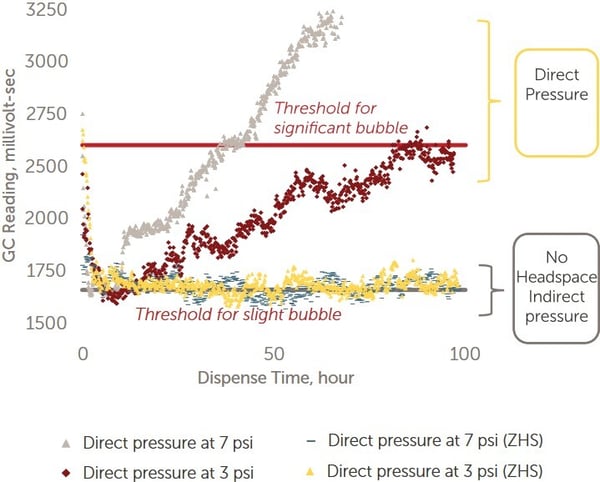
Measured gas chromatograph (GC) response versus dispense time for direct and no-headspace indirect pressure delivery systems.
The figure illustrates how gas evolution can vary significantly depending on how pressure is applied during material delivery. Materials exposed to different delivery conditions can arrive at the point of dispense with different gas characteristics, despite undergoing the same downstream process. The interface may already reflect the cumulative effects of events that occurred long before coating, bonding, or curing begins.
Prior to Dispense, the Material Is Already Changing
Advanced packaging processes are often optimized around the moment material is deposited, coated, or bonded. But by that point, the material has already been shaped by a sequence of upstream conditions that can contribute to defect mechanisms. As viscosities rise and interfaces become more performance-critical, those upstream influences become harder to separate from the final package outcome. The focus shifts from diagnosing the interface as a single failure point to understanding the material journey that created the conditions for that interface to form. High‑Viscosity Materials Flow and Defect Mechanisms
The Visibility Gap
This creates another challenge. Many process-control strategies are designed to detect issues once they become visible within the process. However, some material changes can remain difficult to observe until they appear as yield loss, reliability concerns, or performance variation further downstream.
As materials become more interface-defining, understanding what happened upstream may become as important as monitoring what happens in the process itself. The goal is not simply to detect defects. The goal is to understand and control the conditions that create them.
Looking Upstream
Understanding how packaging, storage, filtration, delivery, and dispense affect high-viscosity materials provides a different perspective on materials integrity in advanced packaging. Rather than viewing defects as isolated process events, it encourages engineers to consider the complete material journey that precedes interface formation.
The full white paper explores the mechanisms behind these observations, including pressure-induced gas evolution, delivery-system effects, monitoring limitations, and practical considerations for reducing bubble-related defects in advanced packaging.
Download the white paper: High-Viscosity Materials Integrity Challenges in Advanced Packaging