


What a Decade of Photochemical Purification Taught Us as EUV Scaled
As EUV scaled into high‑volume manufacturing, yield challenges didn’t just intensify—they moved upstream.
Defects that were once statistically averaged out by larger features and thicker resists became deterministic, chemistry‑driven limiters that could no longer be corrected downstream.
Over the past decade, lithography defectivity has therefore not merely increased in difficulty, it has shifted in origin. As EUV entered production, dominant yield‑loss mechanisms evolved beyond particles and geometric effects toward upstream, chemistry‑driven contamination in photochemical materials and delivery systems. This shift did not replace earlier defect mechanisms; it marked the point at which previously secondary chemical effects became deterministic contributors to yield loss.
In parallel with this transition, photochemical purification technologies evolved through a decade of sustained, problem‑driven development closely tracking the defect sensitivities exposed as EUV matured into HVM.
Larger Features, Thicker Films, and Forgiving Margins
Before EUV, lithography processes benefited from larger feature volumes and thicker photoresist films. Dissolved metals and other molecular‑scale species were often present at low concentrations, but their effects were largely statistically averaged out. Under these conditions, particle filtration and downstream process optimization were sufficient to manage defectivity, and tolerance to chemical variability remained relatively high.
As scaling progressed, however, this buffering effect diminished.
When EUV Removed the Buffer
With EUV, thinner films, smaller feature volumes, and higher chemical reactivity dramatically reduced tolerance to chemical variability. Although dense line/space dimensions shrank by only a factor of two to three, yield sensitivity to chemistry collapsed by orders of magnitude.
Contaminants that were previously benign were no longer averaged out. Instead, they established exposure‑defined chemical states that persisted through coating, bake, exposure, development, and pattern transfer.
The evolution of defect sensitivity as lithography scaled makes this shift explicit—showing how dominant yield‑limiting mechanisms moved from particle‑averaged effects toward dissolved metals, molecular defect precursors, and eventually chemistry‑ and reaction‑driven variability as EUV matured into HVM.
|
Lithography Era
|
Yield Sensitivity
|
|
193i
|
Particles largely averaged out
|
|
Early EUV
|
Dissolved metal sensitivity emerges
|
|
Mature EUV
|
Molecular defect precursors dominate
|
|
Advanced / High-NA EUV
|
Chemistry and reaction sensitivity limits yield
|
Dissolved Metals as Deterministic Defect Drivers
Across multiple generations of scaling, dissolved metallic contaminants emerged as the most consistent non‑particle defect drivers.
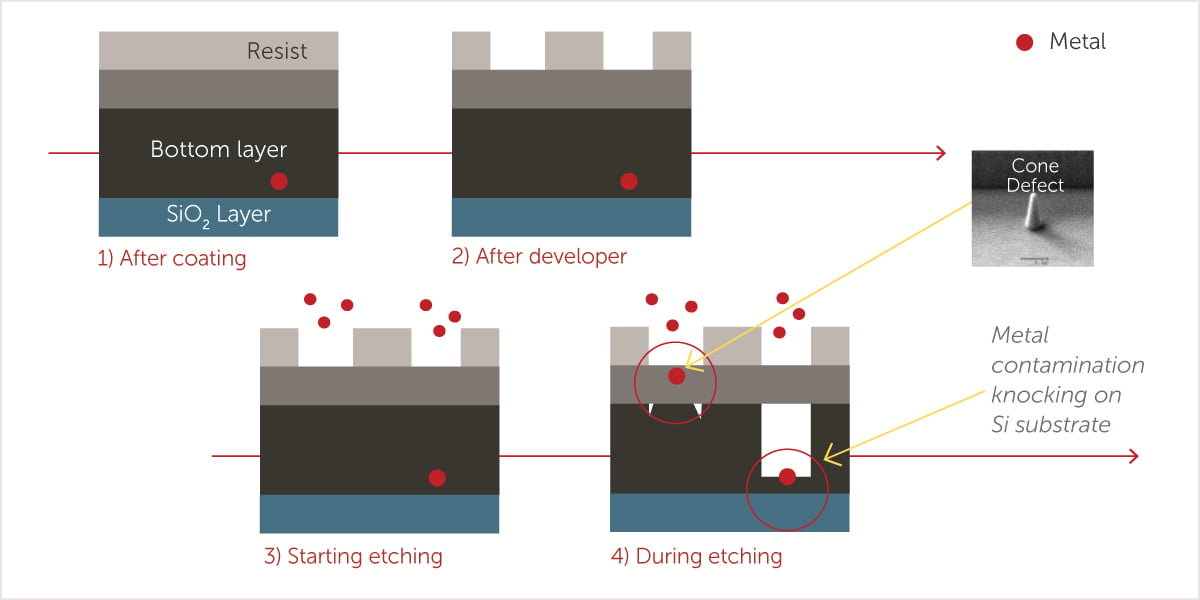
Metallic species present at parts‑per‑billion to parts‑per‑trillion levels were shown to seed bridge defects, microbridges, and cone defects that survived multiple downstream process steps. Unlike particulate defects, these precursors are molecular in nature and often evade detection until after pattern transfer or electrical test.
Once incorporated into the photochemical film, these chemical states cannot be reversed. Yield, in many cases, is therefore defined upstream of exposure. This irreversibility is critical: by the time defects are visible, the opportunity for corrective action has long passed.
 Why Filtration Alone Was No Longer Sufficient
As defect precursors transitioned from particulate to molecular, mitigation strategies had to evolve.
Purification effectiveness became governed less by pore size and more by adsorption‑dominated, chemistry‑aware capture mechanisms. Over the past decade, studies demonstrated that metal removal efficiency depends strongly on solvent polarity, formulation chemistry, and interaction with purification media - confirming that purification performance is inherently chemistry‑specific.
As lithography materials evolved to include polymers, additives, and underlayers representative of real manufacturing flows, purification challenges became more demanding. Polymer‑containing systems revealed that metal–polymer interactions can stabilize defect precursors, reinforcing the need to validate purification strategies under realistic, fab‑representative conditions.
When Stability Became a Yield Variable
At the most advanced applications, yield sensitivity increasingly arose not from new contaminant classes, but from reaction pathways activated once chemical stability margins were exhausted.
Residual acidity did not emerge as a new primary defect mechanism. Instead, it functioned as a reaction‑enabling variable, exposing latent pathways that generated defect‑forming by‑products in chemically fragile systems. In response, purification technologies evolved further and maintained effective contaminant removal while suppressing reaction‑enabling side effects.
At this stage, purification became not only chemistry‑specific, but reaction‑aware.
Photochemical Purification as Early Exposure Control
Viewed across a decade of development, photochemical purification emerged as a form of early exposure control.
Chemical states established during material delivery persist through lithography and pattern transfer, influencing defectivity, pattern fidelity, electrical variability, and long‑term device reliability. As EUV - and now High‑NA EUV - continues to compress margins, this upstream control increasingly defines downstream outcomes.
Looking Back to Understand What Changed
Ten years of photochemical purification development, running in parallel with EUV’s path into high‑volume manufacturing, reveal a consistent conclusion. As EUV scaled, yield challenges migrated upstream requiring equally scaled innovation in how photochemicals were purified, stabilized, and delivered. This evolution did not occur through singular breakthroughs, but through sustained, chemistry‑aware refinement aligned with the realities of advanced manufacturing. Together, these advances illustrate how defect prevention matured from a supporting safeguard into a foundational element of yield enablement in advanced‑node lithography.
Download the full paper and contact the Entegris experts to learn more.