


Solving Bridge Defects in EUV CAR Resists with Advanced UPE Filtration
Bridge defects in EUV chemically amplified resists (CARs) are a persistent yield limiter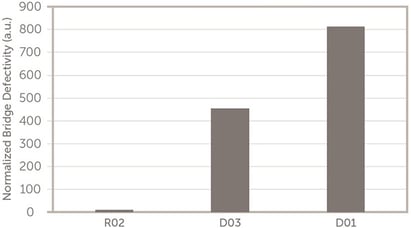 in advanced node semiconductor manufacturing. These defects, often caused by rigid molecular aggregates, compromise pattern fidelity and wafer yield.
Experiment: To address this challenge, Entegris collaborated with imec to evaluate a new generation of ultrahigh molecular weight polyethylene (UPE) filters. The study focused on how membrane architecture and pore size influence the retention of bridge-forming contaminants during EUV CAR coating and exposure.
How We Solved It: Two advanced UPE membrane-based filter, R02 and DR5 (Impact™ 8G), were tested in a TEL Clean Track LITHIUS Pro™ Z module using a standard EUV CAR formulation. The wafers were exposed on an ASML NXE3400B scanner and inspected for bridge defects using brightfield and SEM tools.
- R02 Filter: Engineered with an tortuosity-enhanced membrane to trap gels and aggregates without sacrificing flow rate.
- DR5 Filter: Designed with precisely tailored pore sizes to target rigid molecular contaminants while maintaining membrane integrity.
Key Results:
- Size exclusion is critical: Filters using sieving mechanisms outperformed those relying on non-sieving interactions.
- DR5 leads in defect reduction: It achieved over 60% fewer bridge defects compared to earlier designs.
- Pore size matters: A strong correlation was observed between pore size and defectivity, validating the importance of precision membrane engineering.
Conclusion:
This study confirms that advanced UPE filtration is a powerful tool for reducing bridge defects in EUV CAR processes. As fabs scale toward sub-3 nm nodes and deploy high-NA EUV systems, filtration strategies must evolve to match the increasing sensitivity of materials and processes.
Future work will explore deeper molecular interactions and refine membrane designs to further enhance defect mitigation. These insights will guide the development of next-generation filters optimized for the most demanding lithography environments.
Explore the full technical paper and contact our team to learn how Entegris filtration solutions can support your advanced node manufacturing goals.